

Ballarat Gold-Copper Project Gold and Copper Exploration Project
White Gold District Gold, Copper
Yukon Territory, Canada
Stakeholder Gold Corp. holds a 100% ownership interest in the 19,440-hectare Ballarat Gold-Copper Project located in the Heart of the White Gold District of the Yukon Territory, Canada. The Yukon Territory is a Tier-1 Mining Jurisdiction hosting globally competitive mineral endowments in a regulatory environment favorable to responsible extractive initiatives.
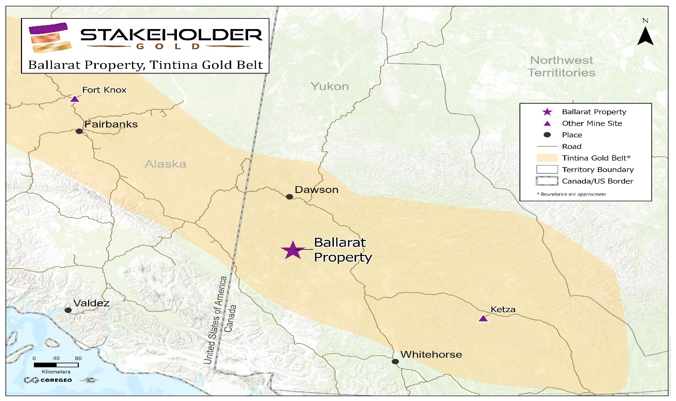
The Ballarat Gold-Copper Project is located within the prolific Tintina Gold Province which extends for more than 1,000 km from the Yukon Territory into the State of Alaska along the northern length of the North American Cordillera (Figure #1).
Figure #1 Tintina Gold Belt
The Ballarat Gold-Copper Project covers 19,440 hectares and is situated northeast of the Newmont Corp. (NYSE: NEM) Coffee Mine Project, due north of the Western Copper and Gold Corp. (TSX: WRN) world class Casino Project and south, west and east of the White Gold Corp. (TSX-V: WGO) White Gold Project (Figure #2).
The Company’s Ballarat Project claim group also includes title to 10 claims located within the nearby Fuerte Metals Corp. (TSX-V: FMT) Coffee Mine Project which is being developed by Newmont Corp. (NYSE: NEM) south of the Yukon river (Figure #2).
Figure #2 Ballarat Gold-Copper Project, Regional Setting
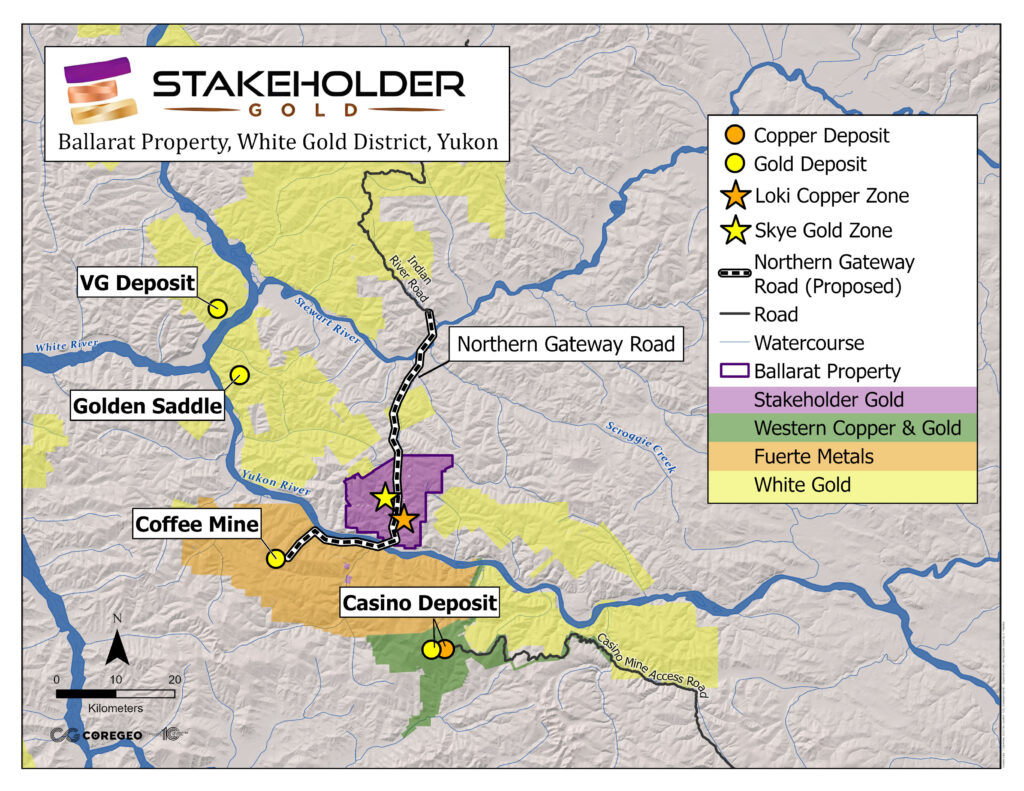
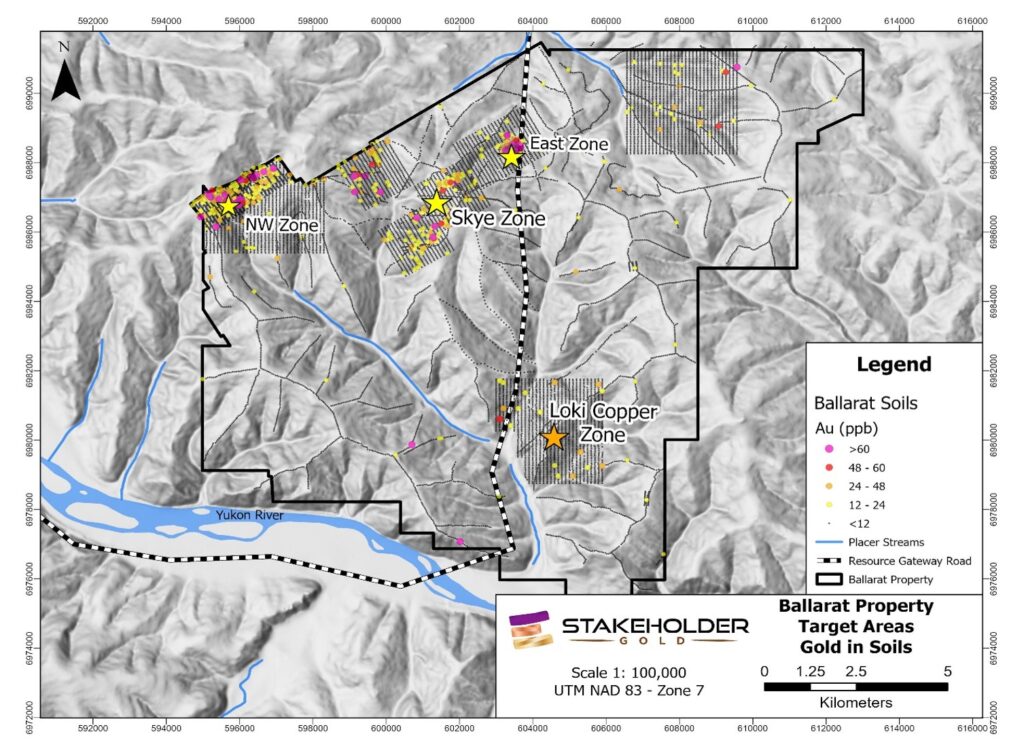
The Ballarat Gold-Copper Project is located in the center of the prolific White Gold District. An estimated 17 km of the Northern Gateway Road which is planned to connect Dawson City with the Coffee Mine Project will be developed through the middle of company claims. The Resource Gateway Road will bring significant logistical advantages to project development and will support the long term economic prospects of the entire district (Figure #3).
Figure #3 Ballarat Gold-Copper Project, Property Details
Skye Gold Zone
The Skye Gold Zone is located in the north-center section of the Ballarat Gold-Copper Project claims and consists of two, subparallel, 1.9 km and 1.3 km gold in soil trends associated with ENE oriented structures. The southern of these two structures is also open to the southwest. These subparallel structures are found to be coincident with low-resistivity zones outlined in VLF-EM surveys. These low resistivity zones dip moderately to steeply northwest and are interpreted to be primary structural controls for gold mineralization in the district.
This structural setting is very similar to other known zones of gold mineralization in the area, including the Golden Saddle Deposit, which is located some 30 km to the northwest.
The Skye Gold Zone is situated north and east of Ballarat Creek within the northwest sector of the Company’s claim holdings. It is located approximately 1-3 km west of the route proposed for the Northern Gateway Road where it is expected to traverse the northern section of Company claims.
Loki Copper Zone
The Loki Copper Zone is located approximately 8 km SE of the Skye Gold Zone and consists of a 2.3 km x 530 m anomalous copper in soils signature associated with a WNW trending Jurassic aged intrusive unit. This intrusive unit is assigned to the Minto Suite.
This structural setting and Minto Suite affiliation indicates potential for mineralization similar to the Minto Mine Cu-Ag-Au, which is located some 92 km to the southeast.
The Loki Copper Zone is situated east of Ballarat Creek within the southeast sector of the Company’s claim holdings. It is located approximately 1 km east of the route proposed for the Northern Gateway Road where it is expected to traverse the southern section of Company claims.